Application of SDS/MSDS in Import & Export Trade and Bonded Logistics
Introduction: Customers and colleagues in the warehousing and logistics industry who frequently engage in import and export trade are no strangers to SDS/MSDS. We hope the following information we have compiled will help you quickly find the information you need from a complex SDS/MSDS. (The full text is approximately 1,470 words and takes about 5 minutes to read)
I. Introduction to SDS/MSDS
MSDS (Material Safety Data Sheet) and SDS (Safety Data Sheet) are both abbreviations for Chemical Safety Technical Specifications. They are documents used by chemical manufacturers and importers to clarify the physical and chemical properties of chemicals (such as PH value, flash point, flammability, reactivity, etc.) and the potential hazards to the user's health (such as carcinogenicity, teratogenicity, etc.). The difference between them mainly lies in the name and the standards used for formulation. SDS is the updated version of MSDS, emphasizing more comprehensive chemical safety data tables and establishing globally universal standards and guidelines.
According to the requirements of the national standard "Content and Item Order of Chemical Safety Technical Specifications" (GB/T 16483), the chemical safety technical specification includes 16 major safety information and safety guidance items such as chemical and enterprise identification, hazard overview, composition/information on ingredients, first aid measures, fire-fighting measures, handling and storage, and transport information.
II. Uses and Importance of SDS/MSDS
SDS/MSDS reports have important uses in the import and export, customs clearance, transportation, and warehousing stages, mainly reflected in the following aspects:
- Customs: Used to determine whether the components of the product are prohibited items.
- Customer Requirements: Regulations vary by region. SDS/MSDS reports can meet customers' needs for understanding product safety characteristics. Compliant chemical exporters will prepare SDS/MSDS before export, and importers will request SDS/MSDS from exporters before import to understand the relevant information of the chemical in more detail and arrange subsequent work such as import customs declaration, transportation, loading and unloading, and warehousing in a legal and compliant manner.
- Freight Forwarding/Customs Clearance: Helps understand product transportation requirements for safe transport. Every chemical or hazardous item has a corresponding SDS/MSDS, which needs to be printed with the letterhead of the relevant production factory. When booking for chemical exports, SDS/MSDS and relevant hazardous goods identifications must first be provided to the shipping company. Shipping companies have specialized departments to review chemical names. Export customers should note that the name on the SDS/MSDS, relevant non-hazardous goods identification certificates, and the name on the export bill of lading must remain consistent.
- Enterprise Safety Management: Logistics and warehousing enterprises implement strict safety supervision and management through SDS/MSDS. Chemicals with different physical and chemical properties may pose risks during transportation and storage. It is necessary to understand the hazardous characteristics of the products to eliminate safety hazards.

III. Quick Query of SDS/MSDS
SDS/MSDS is like a dictionary handbook that can be consulted at any time when needed. Usually, when we read a document, we are used to starting from the beginning and following a step-by-step process. However, when reading an SDS/MSDS, you should search purposefully, grasp the most important information, and quickly find what you need most.
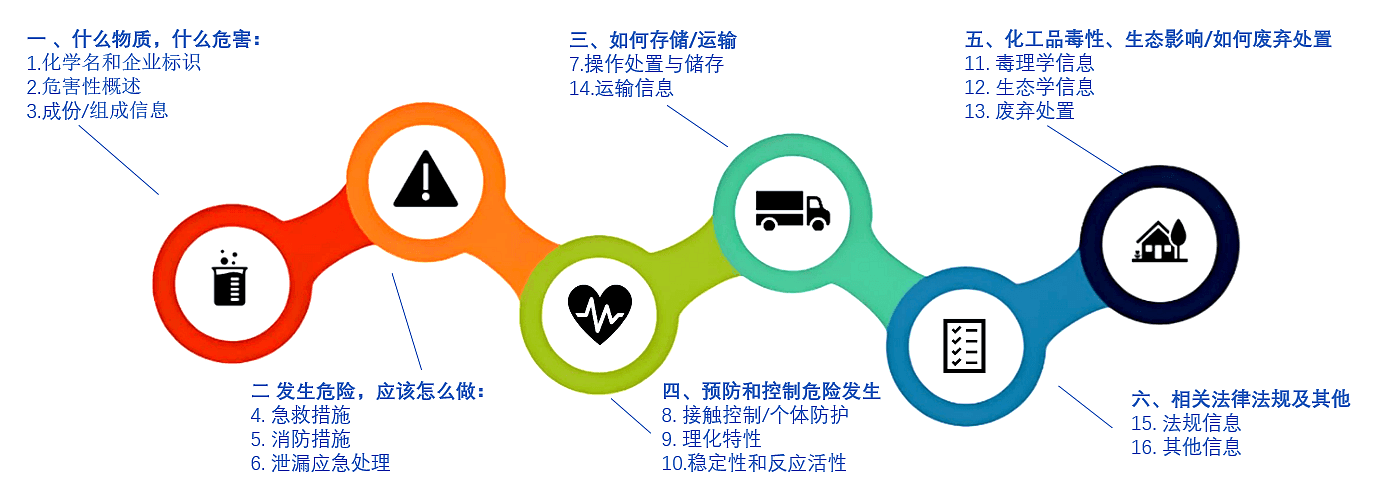
To understand what the substance is and its hazards, look at Sections 1, 2, and 3:
- Section 1. Product & Company Information
- Section 2. Hazards Identification
- Section 3. Composition/Information on Ingredients
For information on emergency disposal in case of an accident, look at Sections 4, 5, and 6: (How to handle after contact, what type of fire-extinguishing equipment to use, how to handle leaks, etc.)
- Section 4. First Aid Measures
- Section 5. Fire Fighting Measures
- Section 6. Accidental Release Measures
For information on how to store/transport, look directly at Sections 7 and 14 (these are closely monitored in the warehousing and transportation stages).
- Section 7. Handling and Storage
- Section 14. Transport Information
To know how to prevent and control hazards, see Sections 8, 9, and 10:
- Section 8. Exposure Controls/Personal Protection
- Section 9. Physical and Chemical Properties
- Section 10. Stability and Reactivity
The remaining Sections 11, 12, and 13 mainly discuss chemical toxicity, ecological impact, and waste disposal.
- Section 11. Toxicological Information
- Section 12. Ecological Information
- Section 13. Disposal Considerations
Sections 15 and 16 provide relevant laws, regulations, and other information.
- Section 15. Regulatory Information
- Section 16. Other Information
For import/export customers, warehousing and logistics companies, or shipping enterprises, upon receiving an SDS/MSDS, one can generally look directly at the CLASS (hazard class) and UN (international hazardous goods code) in Section 14 to determine if it is a hazardous item or a general chemical. Then, based on the PACKING GROUP (packaging method), and combining Section 7 (Handling and Storage) and Section 14 (Transport Information), choose the appropriate packaging, transportation, warehousing, and handling methods. There are many types of chemicals and hazardous items, and the relevant laws and regulations of different countries vary significantly. Sometimes, a cargo might be treated as general cargo in the exporting country but needs to be imported as hazardous goods in the importing country; in such cases, the exporter must follow all the requirements of the importer during the booking and transportation stages.
Conclusion
It is crucial for customers to understand the relevant laws and regulations of the importing and exporting countries before operations and to choose an experienced and compliant supplier. EKUN, an integrated bonded logistics service provider with 26 years of deep cultivation in the field, continues to help customers complete various import and export operations safely and efficiently. We hope you will continue to follow the relevant industry knowledge we share and look forward to win-win cooperation.